The Lagoon
Gray whales in winter sanctuary.
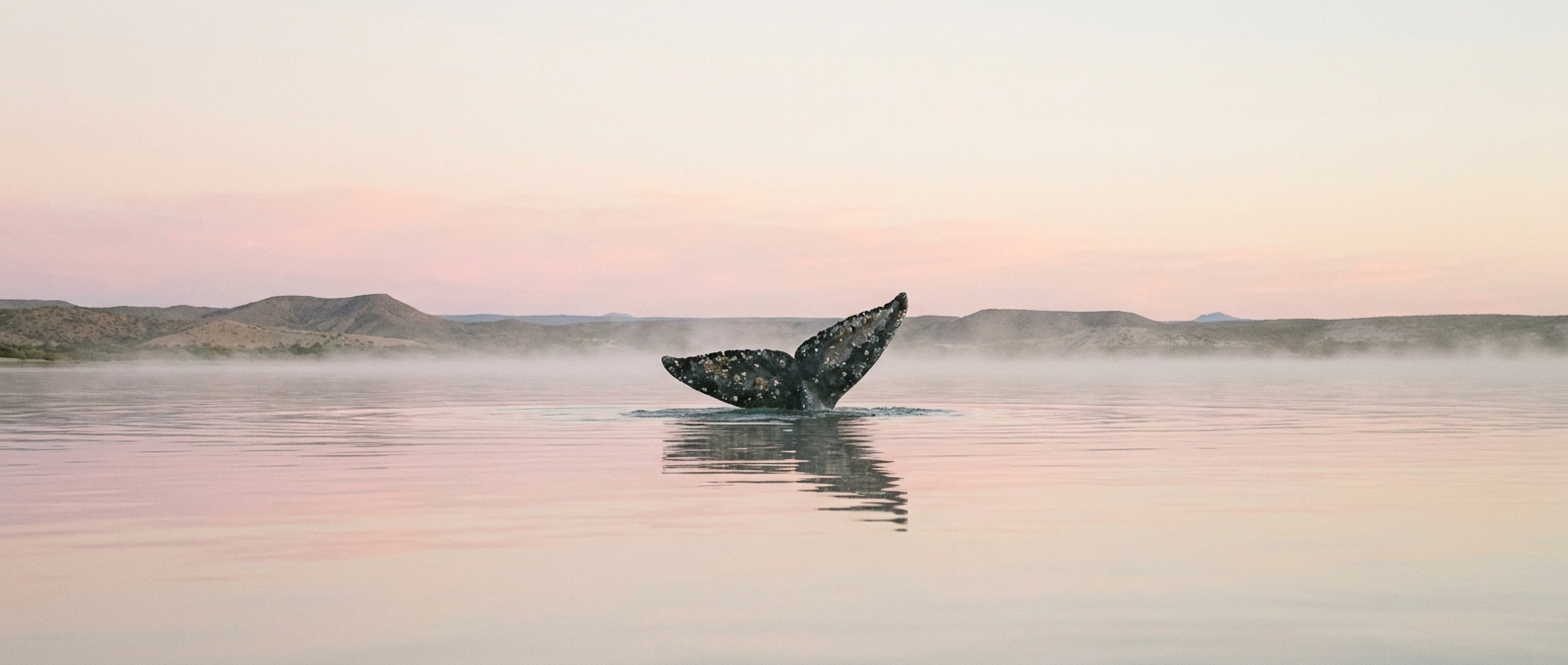


A day on the water with the Pacific gray whales that winter in these protected lagoons to mate and calve, December through April.
Every December, Pacific gray whales begin an 8,000-kilometer journey from the Bering Sea to the lagoons of Baja California Sur. By January and February, thousands of these whales—some weighing up to 36 metric tonnes—have arrived at the Magdalena Bay complex to mate, calve, and nurse their young. It is one of the most significant marine mammal gatherings on the Pacific coast.
Almejas Bay comprises the southern and less-developed portion of the Magdalena Bay complex. Here, under CONANP protection, you will encounter gray whales on their breeding grounds. Depending on the timing of your visit, you may witness mating whales, newborn calves alongside their mothers, or pods in transit. All approaches respect CONANP distance protocols and the spatial needs of the whales themselves.
Meet your naturalist guide at your hotel lobby in La Paz in early darkness, ready for the 2.5-hour drive north and west to Puerto Chale, a working fishing village on the Pacific side. The route crosses the peninsula toward the coast; coffee and a bathroom break are provided en route. Arriving at Puerto Chale, you meet your panga captain, review the day's approach, and board the vessel for the short transit to Almejas Bay proper.
Once on the water, your naturalist guide works with the captain to locate whales. The Magdalena Bay complex is a calving ground; sightings are frequent in-season. You will search for and observe gray whales at CONANP-approved distances, typically 30 meters for passive observation and 80 meters for approach. Depending on the date and the behavior of the whales, you may see mating aggregations, mother-calf pairs, or solitary whales in transit. Your guide provides real-time ecology: the whales' origin (Bering Sea), their breeding cycle, and the role of Almejas Bay in their annual circuit. Mid-morning, a picnic lunch is served aboard or onshore depending on conditions. Whale watching resumes afterward, with the goal of maximizing water time across different areas of the bay as conditions and whale presence suggest.
Depart Puerto Chale by mid-afternoon for the 2.5-hour drive back to La Paz. The route retraces the morning approach; a comfort break is provided. You arrive back in La Paz by evening with ample time for dinner reservations or further exploration of the city. Depending on your schedule, the experience accommodates early or late return windows.
A naturalist trained in gray whale behavior and marine ecology, fluent in English and Spanish. Provides real-time interpretation of whale behavior, breeding cycles, and the significance of the Magdalena Bay complex in the Pacific gray whale migration. Works directly with the panga captain to optimize sightings and safety.
A licensed captain with extensive experience navigating Almejas Bay and locating whales in-season. Operates the panga according to CONANP regulations and safe boating practices. Manages all approach distances and timing to protect whale welfare.
RED's operations team coordinates all transfers, timing, and contingency planning. Manages group size, equipment, and communications with local partners. Provides real-time adjustments to the itinerary based on weather, sea conditions, and whale activity.
Whale watching is a day experience, suitable for travelers with modest flexibility and comfort in open water. Unlike a multi-day immersion, this is entry-level access to one of the Pacific's most significant annual events. It pairs well with stays in La Paz or as a complement to a longer journey through the peninsula.
If you have a traveler who is motivated to see gray whales in their winter breeding grounds, who is comfortable in small boats and full-sun conditions, and who can commit to a 9–10 hour day, describe the month you're considering and your group size. We will respond within two working days with available dates, logistics, and terms.